01
Contextualise it where you are
Talk to the book, then sit with how the framework lands in your own life and community. The point is not more data — it is meaning, named in your own words and your own place.
An art-science experiment — use with caution
What is Endo Violence?
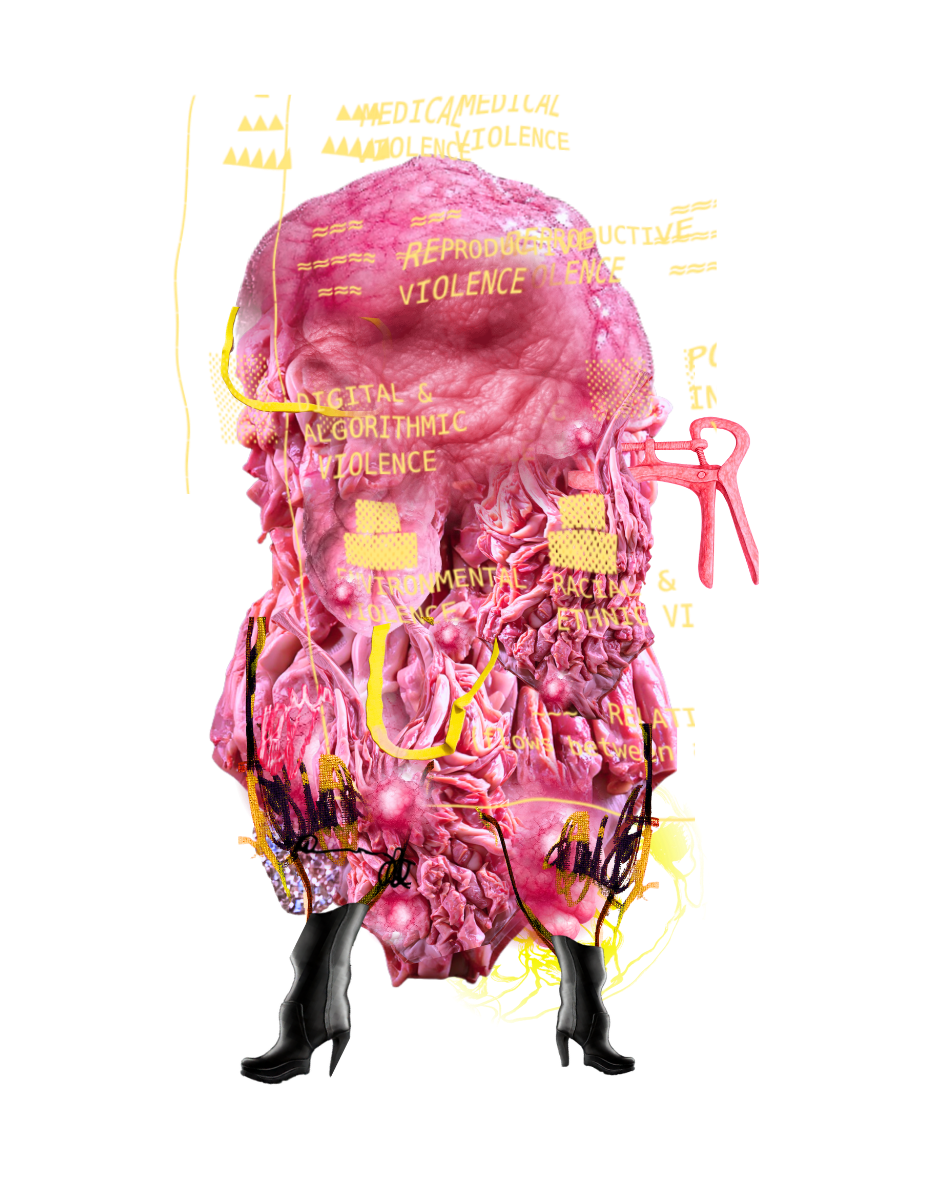
Art · Mixed Media · Produced by HYSTERA
Rooted in medical misogyny, ableism, racism, colonialism, and socio-economic injustice, it manifests through:
It extends beyond the medical field to encompass social, cultural, economic, digital, and environmental injustices. It is, in the framework's own words, both a theoretical lens and a community-led practice of resistance and advocacy — grounded in intersectional and feminist analyses.
Endo violence is structural, epistemic, interpersonal, affective, digital and environmental — a layered, shifting and intersectional terrain, not a flat clinical model.— Endo Violence (2025)
At its root
embedded in systems
who gets to know and be known
family, work, intimacy
grief, rage, numbness, shame
moderated, surveilled, performed, erased
extractive economies, contaminated lands
![Endo Violence: [co]defining endometriosis related injustices - Book cover by Alicja Pawluczuk PhD / HYSTERA with the Endo Violence Community](/images/endo-violence-book.png)
Click to visit endoviolence.com
Why the word "violence"?
The word is not chosen lightly. It is chosen because it is precise. Violence, in this framework, is the patterned production of harm through structural neglect, institutional silence, and cultural dismissal — what is done, but also what is withheld: care, rest, diagnosis, dignity.
Endo Violence — “On naming / why we use the word violence”Medical neglect is violence. Being disbelieved is violence. Waiting eight years for a diagnosis because of gender bias is violence. The word holds the weight that softer language cannot.— Endo Violence (2025)
Nonviolence is not simply a passive practice or a moral ideal. It is an ethical obligation arising from the understanding that we are fundamentally dependent on one another.— Judith Butler (2021), cited in the framework
Resource Mapping & Mutual Aid
The purpose of this map is to help you discover the invisible networks and actors that might support you — and to identify the gaps between services or missing resources. For this example, we use UK-based resources, but the framework is designed to be adapted for any location. Select a violence type to reveal connected resources.
By mapping what exists and what is missing, we can help each other, build new networks, and advocate for better services.
Edited by Allison Rich, co-founder of the Endo Violence Collective and filmmaker of Not Normal.
Note: Examples shown are UK-focused. Adapt the questions to map resources in your own region.
A living, collective project
Endo violence lives in systems, not just in individual bodies — so understanding it, and doing something about it, happens together. This framework was co-defined with people living with endometriosis, and it is meant to keep growing. You are warmly invited to bring it into your own context.
Talk to the book, then sit with how the framework lands in your own life and community. The point is not more data — it is meaning, named in your own words and your own place.
Use the community resource map to chart local and online support — anywhere in the world. Share back what you find so others nearby do not start from zero.
Borrow the method: a room, some tea, zine-making, and people who believe each other. The printable guide walks you through it. No funding or permission needed.
The book is open-source for non-commercial use. Translate it, adapt the ten types to your context, add what is missing, and pass it on.
Guided by healing justice: this is not about blaming any individual clinician or organisation. It is about understanding how systems join up — and what becomes possible when communities come together.
How to use this resource
This framework and map can be used in many ways depending on your context and goals. Here are some starting points for different stakeholders.
How to cite
Pawluczuk, A. (HYSTERA), with the Endo Violence Community (2025). Endo Violence: [Co]Defining Endometriosis Related Injustices. Available at: endoviolence.com (Accessed: June 12, 2026)
This is a living document. The framework continues to evolve through collective practice and feedback. When citing, please include your access date (as shown in the citation above).
This resource was created with the assistance of AI tools and on crip time — honouring the author's experience as a disabled and neurodivergent person living with endometriosis. While we strive for accuracy, please always verify sources and consult the original research linked throughout.
About Us
We are a community of people with endometriosis, researchers, artists, and activists working together to name, map, and challenge the systemic injustices faced by those living with this condition. Through art, research, and collective action, we aim to transform how endometriosis is understood, treated, and talked about.
Visit endoviolence.comZines & Publications
A series of community-driven zines exploring endometriosis-related injustices, personal stories, and collective knowledge. Click to read online.